Manufactory Record
Manufacture nationale de Sèvres
Sèvres, Hauts-de-Seine, Île-de-France, France
Institutional Note
Brief note for this atelier, firm, or manufactory (typically three paragraphs; five maximum).
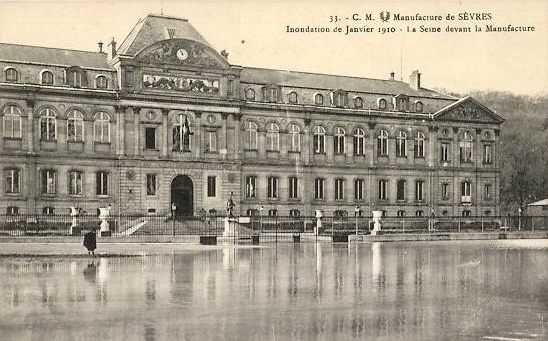
The Manufacture nationale de Sèvres originated in 1740 as a privately established soft-paste porcelain workshop at the Château de Vincennes. Supported by Louis XV and Madame de Pompadour, it moved to Sèvres in 1756 and became a royal manufactory in 1759. Its title changed with successive political regimes — royal, imperial and national — but its close relationship with the French state remained constant. In 1876 the Manufacture and its ceramics museum moved into the purpose-built complex beside the Seine and the Parc de Saint-Cloud that the institution continues to occupy today.
By the end of the nineteenth century, however, Sèvres faced the challenge of reconciling its historic prestige with the new artistic ceramics emerging from independent workshops. Its presentations at the universal exhibitions of 1878 and 1889 received a mixed response, and the leadership was unsettled: Charles Lauth was forced out in 1887, the celebrated Théodore Deck held the directorship until his death in 1891, and the ministry then changed the shape of the office altogether. Instead of a single director it appointed an administrator, Émile Baumgart, supported by a technical director and a director of artistic work — the divided structure that would govern the Art Nouveau years. After two short tenures in the artistic post, the second by the medalist Jules Chaplain, Baumgart in 1897 gave it to Alexandre Sandier (1843–1916), until then head of the decoration workshops, and did so expressly with the Exposition Universelle of 1900 in view. Sandier held the post until his death in 1916. He introduced Art Nouveau into the Manufacture’s repertory through simpler silhouettes, softer and frequently pastel colors, continuous decoration flowing around the vessel and a reduced dependence upon elaborate gilt-bronze mounts. Hundreds of new profiles and models were created by Sandier and a broad circle of staff designers and invited artists.
Technical experimentation supported this stylistic transformation. Sèvres worked simultaneously in hard-paste porcelain, biscuit porcelain and stoneware, and Sandier brought in a new grès cérame body that served both small objects and monumental architectural work; the laboratories developed glazes capable of crystalline, opalescent, mottled and subtly iridescent surfaces, and the old models were replaced by forms that required no artifice of assembly. At the Exposition Universelle of 1900 the Manufacture presented an ambitious synthesis of sculpture, architecture and decorative ceramics, including Agathon Léonard’s celebrated biscuit-porcelain dancers, the Jeu de l’écharpe, and monumental installations designed to demonstrate the institution’s renewed modernity. The reversal was severe enough that contemporaries read it as a repudiation: Georges Lechevallier-Chevignard, writing from inside the Manufacture, recorded that Sandier had broken absolutely with every Sèvres tradition and that visitors to 1900 came away with the impression of a complete abandonment of the institution’s past. What in fact persisted was not the style but the plant — the exceptional laboratories, kilns and specialized craftsmen, now turned to Art Nouveau ends. The logic can be seen at its clearest in Léon Kann’s coffee service of 1900–1904, where the fennel plant encases the functional part of every piece and enamel laid on unglazed porcelain gives the matte surface of the plant itself.
Animals formed an important part of this renewal, and the Manufacture had a ready supply. The French animalier tradition was then at its height, and Sèvres drew directly on it: Georges Gardet (1863–1939), a pupil of Emmanuel Frémiet and reckoned the finest animal sculptor of his generation, had model after model editioned by the Manufacture in biscuit and in the new grès cérame. Alongside the invited animaliers the Manufacture had sculptors of its own: Jules Devicq (1867–1930) made vases and figures at Sèvres across nearly five decades, from 1880 to 1928, signing at times with a ligatured JD, and his own stoneware took the form of boldly stylized Art Nouveau flowers, a nenuphar of 1898 among them. An animal could therefore pass from an outside sculptor’s model through a staff modeler’s hands before it ever reached the kiln. An administrative change made such editions far easier. Before 1900 Sèvres had to buy a model outright, and its small budget for the purpose confined production to occasional commissions and reductions of works the State had already acquired; afterward, sculptors lent their models without charge and took a quarter of the sale price instead, which gave the artist a direct stake in the model’s success and let Sèvres reproduce a far greater number of them without paying in advance. The animal repertory expanded accordingly. Mice, tortoises and other creatures appeared as freestanding sculpture, while crabs, frogs and shells determined the forms of bowls, vases and small functional objects. Some works remained closely observed animal studies; others merged creature and vessel so completely that claws became borders, frogs occupied handles and shell structure generated the entire ceramic form. Their varied treatment — from unglazed white biscuit to softly mottled stoneware — demonstrates the Manufacture’s unusual ability to unite scientific observation, sculptural modeling and technical experimentation.
Sèvres occupies a distinctive place within the Bestiaire because its animal ceramics do not represent the vision of one artist or even one workshop master. They are the products of an institutional system in which sculptors, designers, chemists and highly specialized artisans worked together under state patronage, and the objects say so themselves: a Sèvres animal will commonly carry the sculptor’s signature, the manufactory stamp with its year, and the initials of the mouleur-répareur who cast and finished it — three hands recorded on one small base. That transparency about collaborative making is rare in the period and it is one reason the Sèvres pieces read differently from the independent studio work around them. Not everyone admired the arrangement; Auguste Delaherche, who appears elsewhere in these pages, petitioned the State by open letter to close the Manufacture outright, holding that its subsidized competition was unfair to independent artists. At its Art Nouveau peak the Manufacture absorbed the era’s fascination with nature while retaining a precision and technical ambition found nowhere else on the same scale. Its animals range from intimate and humorous domestic creatures to monumental sculpture and fantastic vessels, making Sèvres indispensable to any account of the French ceramic bestiary around 1900.
References
Agathon Léonard: Le geste Art nouveau. Exhibition catalogue, musées de Roubaix and Beauvais; Paris: Somogy, 2003. The standard reference for the biscuit dancers of the 1900 Exposition.
Baumgart, Émile. La Manufacture nationale de Sèvres à l’Exposition universelle de 1900. Paris: Librairie centrale des Beaux-Arts, 1901. An essential contemporary account written by the Manufacture’s administrator.
Lafayette, Tcho-San, Feuilles de carotte… La Manufacture de Sèvres de 1872 à 1905. Exhibition catalogue, Musée des Ursulines, Mâcon: Musées de Mâcon, 2011. Its date range makes it particularly useful for the transition from nineteenth-century historicism to Art Nouveau.
Lechevallier-Chevignard, Georges. La Manufacture de porcelaine de Sèvres. Paris, 1908. An insider’s history, and the source for both the reception of the 1900 display and the royalty arrangement that replaced outright purchase of sculptors’ models.
Midant, Jean-Paul. Sèvres 1900. Exhibition catalogue, Musée des Beaux-Arts de Nancy, Ville de Nancy, 1996. Concentrates specifically on the Manufacture’s production surrounding the Exposition Universelle of 1900.
Midant, Jean-Paul. Sèvres: La Manufacture au XXe siècle. Paris: Michel Aveline, 1992. The opening section is a principal modern reference for Sandier’s directorship and the Manufacture’s Art Nouveau production.
Sandier, Alexandre. Les cartons de la Manufacture nationale de Sèvres: époque moderne. Paris: Ch. Massin, 1912.
Sandier, Alexandre, and Georges Lechevallier-Chevignard. Formes et décors modernes de la Manufacture nationale de Sèvres. Paris: Charles Massin, c. 1913–14. A primary visual record of the modern forms and decorations developed during Sandier’s directorship.