Bestiaire

Animal classification · Iridescent bodies

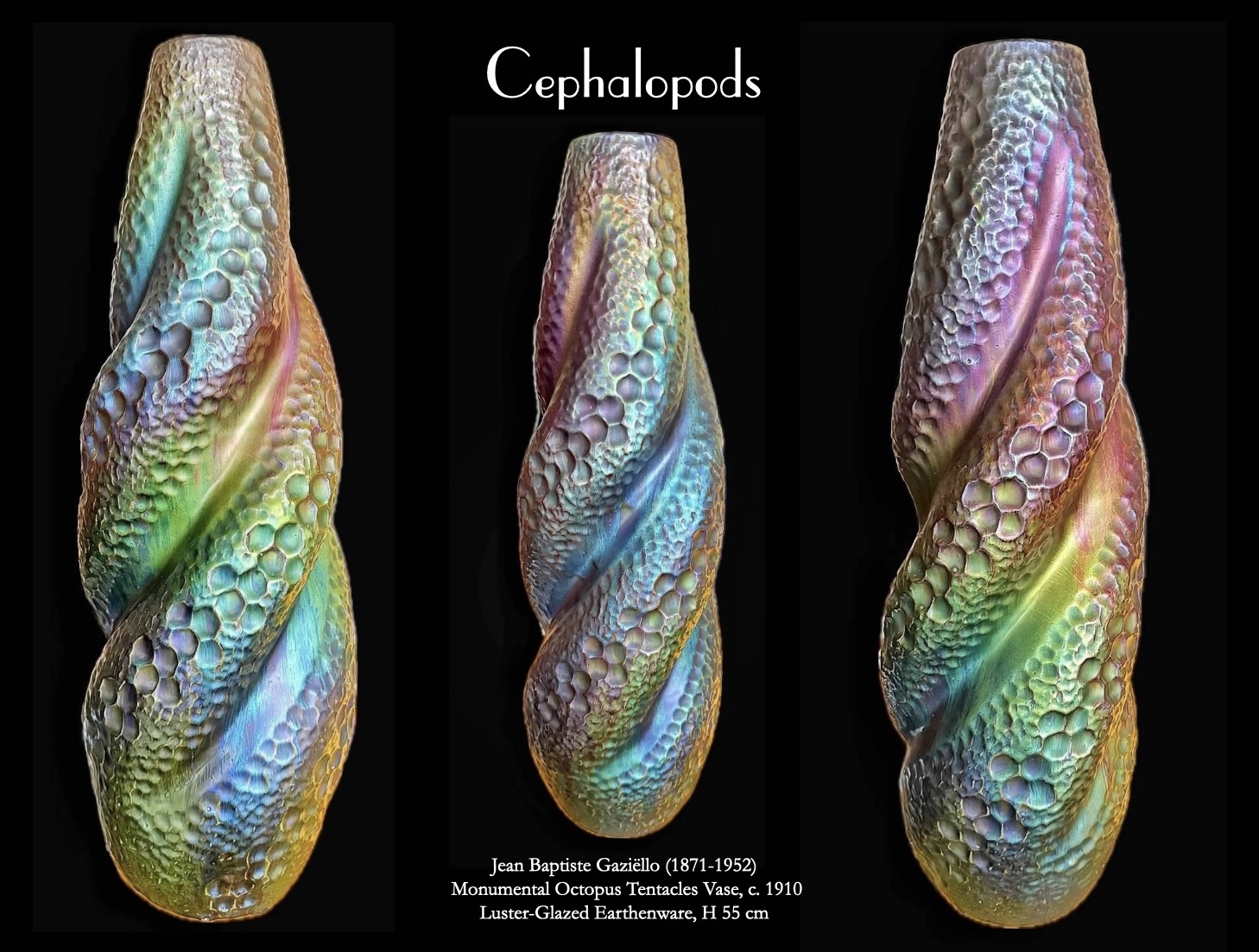
Cephalopods Tentacle, shell, luster, and abyssal light

Where the glaze behaves like water—oil-slick violet, verdigris green, oxidized copper—forms twist into biological architecture. This animal classification follows surface tension: sculptural bodies made to move under spotlight.

Octopus tentacles vase by Jean-Baptiste Gaziello, composite views on black
Primary plate Gaziello · Octopus Tentacles Vase · luster-glazed earthenware · c. 1910
Intro Essay

Cephalopod forms are an Art Nouveau fantasy of motion—spiral, torque, suction, and drift—made legible in clay. Under spotlight, luster behaves like a living skin: it changes as you move, projecting color beyond the object’s edge.

This landing page is designed like a gallery room: a hero plate, an essay, a featured object wall, then a grid you can skim or inhabit. Use it as a classification entry—curatorial text up front, research structure underneath.

Featured Object

Octopus Tentacles Vase

A monument to surface tension: luster glaze fades from pearl to copper to violet, pooling in recesses like tide.

Maker
Jean-Baptiste Gaziello
Date
c. 1910
Technique
Luster-glazed earthenware
Open Object Record

Visual Detail Studies

Cinematic close reads—glaze, relief, silhouette, and shadow.

Iridescent Skin
Pearl → copper → violet shift under raking light
Relief as Diagram
Surface patterns that read like biology
Spotlight Geometry
High points bloom; recesses fall into velvet black

Related Objects

Comparatives that echo luster, relief, and marine imagination.

Commentary

Suggested research axes: luster glaze chemistry and firing regimes, modeled form lineage (animalier ceramics), and atelier cross-pollination with metalwork and glass. Verify maker attributions against workshop marks where possible.

Treat this page as a structured curatorial draft: add verified citations, exhibition history, and photographic detail studies (underside marks, rim wear, glaze pooling) as the archive grows.