Artist Dossier
Alphonse Voisin-Delacroix
Sculptor for Pierre-Adrien Dalpayrat; Symbolist stoneware with spiders, faces and predatory animals among the Bestiaire’s most psychologically charged ceramics.
Biographical Note
Brief biography for this individual (typically three paragraphs; five maximum).
Born Alphonse Voisin at Besançon on 9 September 1857, the sculptor adopted the name Voisin-Delacroix around 1885 in tribute to his maternal grandfather, the architect and archæologist Alphonse Delacroix; through the same family he was a distant cousin by marriage of the Fourierist Victor Considerant, whose portrait he modeled in 1890. He trained under the distinguished sculptor Henri Chapu and pursued a conventional Salon career before turning to ceramics: he debuted at the Salon in 1883, received an honorable mention in 1886 and a third-class medal in 1887, won a bronze medal at the Exposition Universelle of 1889, and exhibited there for the last time in 1890. His early production included portrait busts, commemorative monuments and independent sculpture, establishing the academic modeling skills he would later bring to his collaboration with Pierre-Adrien Dalpayrat.
Voisin-Delacroix met Dalpayrat after the ceramist established himself at Bourg-la-Reine in 1889. The link between them was probably the painter Jean-Adolphe Chudant, a fellow native of Besançon, who leased Dalpayrat the old ceramic factory at 9 and 11 Grande-Rue — long since demolished, and now the site of nos. 33 and 35 avenue du Général-Leclerc. In January 1892 the two men signed a partnership contract with a clear division of labor: Voisin-Delacroix created the sculptural forms, while Dalpayrat selected and prepared the clay and controlled the coloring, glazing and firing. Dalpayrat further undertook to engage no other artists beyond such decorators as he might need, which made Voisin-Delacroix the principal sculptor of the workshop. The arrangement united two complementary talents — one concerned primarily with modeling and symbolic imagery, the other with ceramic chemistry and the transformations of the kiln. Dalpayrat showed his first flamed stonewares at the third Salon of the Société nationale des beaux-arts in May of that year, but the partnership’s first full presentation came in December 1892 at the Galerie Georges Petit: approximately fifty stoneware works, which unveiled the rouge Dalpayrat to the public and greatly strengthened the ceramist’s emerging reputation. Its success carried the work onward to the World’s Columbian Exposition at Chicago in 1893, which opened after the sculptor was already dead.
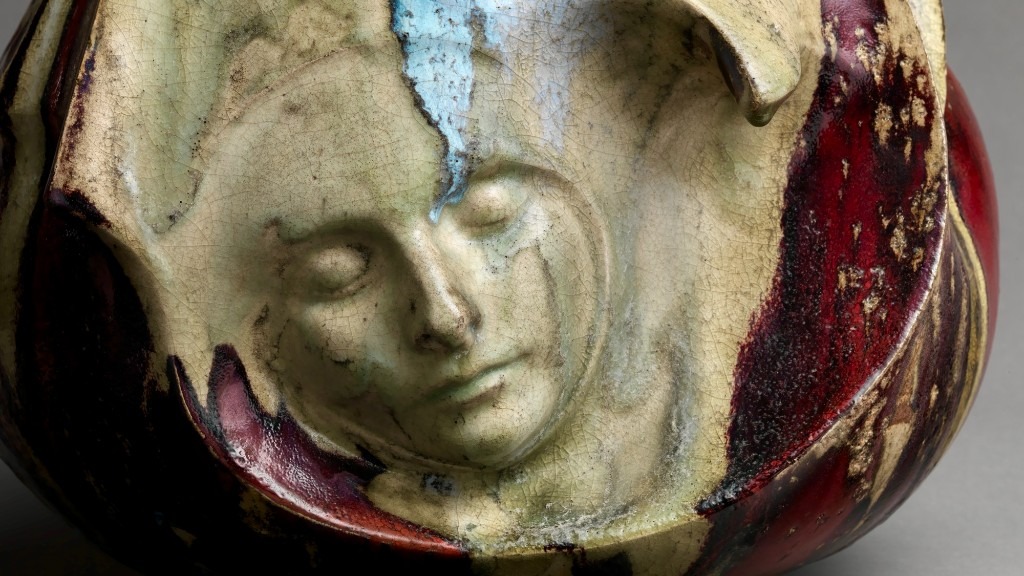
The collaboration produced some of the most psychologically charged ceramics of the early Art Nouveau period. Voisin-Delacroix replaced conventional handles and ornament with crouching figures, sleeping faces, bats, dragons, spiders and predatory animals that bite into fruit or flesh. These beings do not merely decorate the vessels: they seize their rims, emerge from their walls and distort their silhouettes. Gourds and hearts appear bruised, swollen or partially consumed, while human masks seem to surface from beneath the clay. Most of the models were small; the monumental Vase with a Face, now in the Metropolitan Museum of Art, is among the most ambitious things the two of them attempted, presenting a sleeping woman’s features hidden within the vessel’s body and turning Dalpayrat’s streaked copper-red, blue, yellow and white glaze into the atmosphere of a dream. The museum’s record for that vase describes the sculptor as Swiss, and the error has been repeated in the trade; he was born at Besançon and was French. The union of Symbolist imagery with visceral modeling gave their ceramics an unsettling emotional intensity seldom found in contemporary decorative art.
Animals were central to this expressive language. Voisin-Delacroix treated them less as zoological subjects than as embodiments of appetite, menace, entrapment and metamorphosis. In works such as Cœur dévoré par un animal, the creature’s body becomes inseparable from the wounded form it consumes; elsewhere dragons crawl along the edges of shallow vessels and spiders organize the surface through their webs. Dalpayrat’s volatile glazes complete the effect, gathering in recesses, breaking across raised anatomy and making the animals appear to emerge from fire, mineral deposits or decaying organic matter. The sculptor supplied the narrative and physical tension, while the ceramist made those forms seem alive.
The two artists signed a second agreement providing for twelve years of mutual exclusivity, and it had barely taken effect when Voisin-Delacroix died of pleurisy in Paris on 2 April 1893, at thirty-five. Their partnership had run from January 1892 — some fifteen months in all — and in that short span it produced a remarkably coherent and influential body of work. Its afterlife was longer than the collaboration itself: Dalpayrat went on issuing Voisin-Delacroix models from Bourg-la-Reine, and closely related versions of the devoured-fruit vase are recorded around 1900 bearing the later Grands Feux de Dalpayrat mark — so a Voisin-Delacroix model does not by itself establish a date of 1892–93. Voisin-Delacroix brought Symbolist sculpture directly into the vessel, while Dalpayrat demonstrated that glaze and firing could deepen rather than simply reproduce a sculptor’s conception. Their partnership remains one of the clearest examples of genuine collaboration between sculptor and ceramist during the formative years of Art Nouveau.
References
Guillaume, Arielle, Robert Guillaume, Matthieu Pinette and Frédérique Thomas-Maurin. Alphonse Voisin-Delacroix: Ou quand un sculpteur rencontre un céramiste, 1892–1893. Exhibition catalogue, Musée des Beaux-Arts et d’Archéologie de Besançon, 24 April – 5 July 1993; the exhibition traveled to the Musée Joseph-Déchelette in Roanne and the Château-Musée in Boulogne-sur-Mer. This 96-page catalogue is the fundamental monographic study of Voisin-Delacroix and his partnership with Dalpayrat, and its numbered checklist is the reference the salerooms cite.
Makus, Horst, Helen Bieri, André Dalpayrat, Jean Girel and Madeleine Strobel. Adrien Dalpayrat, 1844–1910: Céramique française de l’Art Nouveau — Art du feu. Stuttgart: Arnoldsche, 1998. The principal catalogue of Dalpayrat’s work illustrates and identifies numerous Voisin-Delacroix models and remains essential for understanding how they were realized within the Bourg-la-Reine workshop.
Pinette, Matthieu. “Alphonse Voisin, ou quand un sculpteur rencontre un céramiste, 1892–1893.” Revue de la céramique et du verre, November 1993, pp. 44–45. This concise contemporary article provides an accessible summary of the research surrounding the 1993 exhibition.
Poisson, Georges, Maddy Ariès, Christian Gautier, André Joly and Brigitte Lekieffre. Sceaux – Bourg-la-Reine: 150 ans de céramique. Exhibition catalogue, Musée de l’Île-de-France, Château de Sceaux, 1986, p. 127. Useful for the local context of the Bourg-la-Reine workshops, and cited for Voisin-Delacroix in the standard reference literature.
Tornier, Étienne, and Peter Marino. Adrien Dalpayrat: The Peter Marino Collection. London and New York: Phaidon, 2020. Although devoted to Dalpayrat rather than specifically to Voisin-Delacroix, it provides important modern context for the sculptural collaborations and experimental stoneware production of the Bourg-la-Reine atelier.