Artist Dossier
Jean-Désiré Ringel d’Illzach
Sculptor, medalist, and ceramic modeler whose Alsatian identity and Japoniste bestiary place him among the most distinctive creators of Art Nouveau animal sculpture.
Biographical Note
Brief biography for this individual (typically three paragraphs; five maximum).
Jean-Désiré Ringel d’Illzach was among the most original and experimentally minded sculptors in France at the end of the nineteenth century. Born in Illzach, near Mulhouse, on September 29, 1847, a departmental scholarship took him to Paris as a teenager to study sculpture and music. He trained under François Jouffroy and Alexandre Falguière at the École des Beaux-Arts and also studied with Ernst Hähnel in Dresden. Following the annexation of Alsace in 1871, he added the name of his birthplace to his surname, affirming an Alsatian identity that remained central to his life and work.
Ringel refused to confine himself to a single material or artistic discipline. He worked as a sculptor, medalist, draftsman, printmaker, glassmaker and modeler in polychrome wax, experimenting with vitreous enamels and unusual combinations of bronze and copper. From 1882 his portrait medallions of writers, musicians, scientists and political figures circulated through the journal L’Art, bringing recognition and helping finance his more speculative work. Music was another source of inspiration, particularly in his allegorical interpretations of Beethoven’s symphonies and the theatrical, polychrome Rakoczy March.
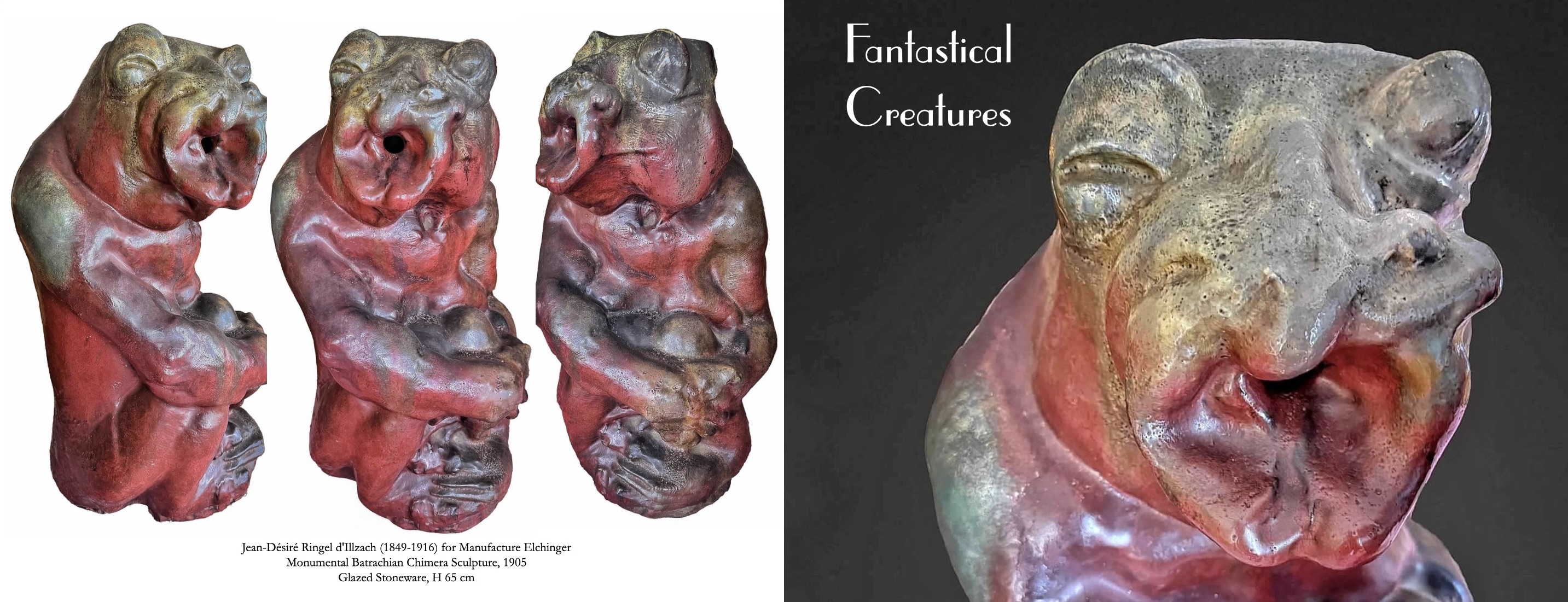
Ringel took up ceramics in the early 1880s at the experimental stoneware workshop Haviland & Co. had established in Paris under Ernest Chaplet — an enterprise that had been a laboratory of Japonisme since Félix Bracquemond directed its Auteuil studio. His designs transformed vessels into sculptural settings populated by acrobats, theatrical figures, mythological subjects and strange animals — and it is in the animals that the Japanese debt shows. The grimacing hybrids and half-human beasts descend from the netsuke and okimono then passing through Parisian dealers, and from the printed repertoire of ukiyo-e and Hokusai’s Manga. What he took was less a set of motifs than a method, and a license to treat the grotesque as a serious subject rather than a decorative aside. He later conceived independent sculptures in stoneware, including the monumental Praying Mantis and Mole Cricket, exhibited in 1896. Back in Alsace, he collaborated around 1905 with Léon Elchinger at Soufflenheim, whose manufactory produced such extraordinary works as The Monkey and the Dolphin and the Batrachian Chimera.
Ringel’s animals are neither conventional decorative motifs nor straightforward studies from nature. Frogs, apes, dolphins, insects and hybrid beasts become psychologically charged creatures, alternately comic, menacing, melancholy or strangely self-aware. Their compressed bodies and mask-like faces carry over the netsuke carver’s habit of packing a whole character into a few cubic inches, along with the fascination with character and inner state that drives his portrait medallions and wax heads. This combination of close observation, grotesque humor and fantastical invention places Ringel d’Illzach among the most distinctive creators of the Art Nouveau bestiary.
References
Alphonse Bertillon’s 1903 photographic portrait of Ringel belongs to the Musée d'art moderne et contemporain de Strasbourg.