Artist Dossier
Franz Metzner
Sculptor of Jugendstil porcelain for KPM Berlin; the Frog King centerpiece among the Bestiaire’s defining amphibian works.
Biographical Note
Brief biography for this individual (typically three paragraphs; five maximum).
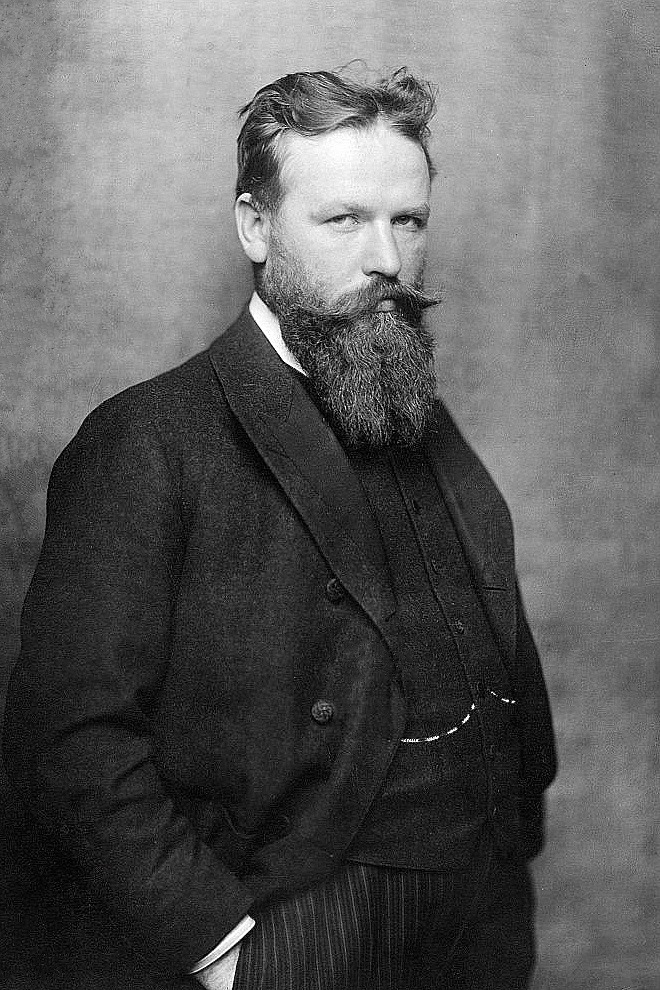
Franz Metzner was born at Wscherau near Pilsen on 18 November 1870, in what was then Austria-Hungary. His father, a farmer and merchant of no great success, practised sculpture himself and kindled the same passion in his son, who is said to have stolen clay from the yard of a ceramic works near the family house for his own early experiments. He was apprenticed in the mid-1880s to a stonemason from Pilsen who also kept a gravestone business, then took to the road, working in Dresden, Cologne and Hamburg before reaching Berlin in 1892 or 1894 — the accounts differ — and opening his own studio at Friedenau in 1896. The years of wandering left him with several trades rather than one — plaster molder, stonemason, stone carver, and for a time a draftsman for illustrated papers — and this practical grounding in carving, modeling and architectural ornament proved essential to his brief but exceptionally fertile career in ceramics: Metzner approached porcelain not as a surface to be decorated, but as a sculptural material capable of carrying weight, emotion and symbolic meaning.
His decisive ceramic period began in the summer of 1898, when his designs started to appear in the model books of the Königliche Porzellan-Manufaktur Berlin. He worked as an outside contributor rather than a member of the staff, paid for each design as it was taken — 17.50 Mark for one in October 1898, rising to seventy for the most ambitious of the vases — and the factory documentation credits him with thirty-nine models between July 1898 and August 1900, with a single jardinière following in February 1903 to make forty in all. It was an astonishingly concentrated burst of invention, and it coincided with two developments at the manufactory that made it possible: the Heinecke body, a porcelain that could be worked freehand like potter’s clay, and the flowing and crystalline glazes introduced at the same moment. His vases, urns, bowls and centerpieces departed sharply from KPM’s historicist traditions. Human faces emerge as handles; masks dissolve into vessel walls; animals and hybrid beings cling to rims or determine entire silhouettes. Metzner studied the technical behavior of porcelain closely, adjusting his reliefs and transitions to accommodate the flow of glaze and the stresses of firing.
His most lyrical ceramic conception is the piece the manufactory entered in its books as a bowl with figure and crowned frog, and which the press of 1900 published as Märchen — Fairy Tale. Modeled in September 1899, it was shown by KPM at the Paris Exposition Universelle the following year. A long, low basin becomes a watery landscape of lily pads, and upon it a nude water sprite — a nixe, as German writers of 1900 called her — leans toward the small crowned frog below. She carries no attribute of rank, and nothing marks her as the princess of the Grimm tale; what the period saw was one water creature meeting another, the frog’s crown the single sign that either is enchanted. Pale green, ivory and rose glazes soften the sculptural transitions and envelop the encounter in a dreamlike atmosphere. The title names the genre and leaves the tale unspoken, which suits the conception: this is not an illustration but a Symbolist meditation on attraction, hesitation and transformation. Its asymmetrical composition, psychological tension and complete fusion of figure and landscape make it one of the most ambitious works of Jugendstil porcelain.
Animals occupied a central place in Metzner’s ceramic imagination, although they rarely appear as straightforward naturalistic studies. His porcelain world runs to frogs, fish, lizards, bats and hybrid beings, often caught in acts of pursuit, consumption or metamorphosis. The model books preserve something of the range — a bowl with pelican and frog of November 1899, now in the Stiftung Stadtmuseum Berlin; a bowl with fish; a vessel in the form of a bat of December 1898; and a vase of October 1899 that the manufactory recorded as a vase with dragons although the creature winding around its body is a lizard. The clerk’s slip is itself a measure of the case: these creatures inhabit a fluid territory between zoology, fairy tale and nightmare. Their bodies are compressed, elongated or merged with the vessel, while graded glazes blur outlines and intensify their mysterious, half-emergent presence.
Paris made him briefly famous and thoroughly controversial. The jury singled his pieces out from the manufactory’s stand for distinction, though the accounts differ on whether the medal was gold, silver or bronze, and the conservative press was appalled. One reviewer catalogued the offenses: a deliberate, sought-after ugliness; the Sphinx of Life shading into caricature; masks of the dying set on a flower tub; bat-winged grotesques; the whole quite the opposite of graceful, and no fit business for a state manufactory representing its country abroad. Of the Märchen he allowed that the water sprite conversing with her frog king was sculpturally well managed, then objected that the frog rose out of a greenish-grey morass and that the rest of the piece was glazed in the colors of a dreadful pond, conceding only that the glazes were technically perfect and did credit to the chemist who had devised them. Richard Graul, writing in the Illustrirte Zeitung the same year, took the opposite view of the same objects, finding fresh artistic force in precisely these glazed and naturalistically decorated vessels by the younger sculptors. A German report on the St. Louis exhibition of 1904 passed along an account of how the association ended: a gifted young artist had made things for the royal manufactory that neither the French nor the Nordic factories could surpass, until someone asked whether nobody could smash these pots, whereupon he was let go. The story is hearsay, but the collaboration was in fact over by the end of 1900.
Metzner moved to Vienna in 1903 to teach at the Kunstgewerbeschule, joined the Vienna Secession and entered Josef Hoffmann’s circle, and returned to Berlin in 1906 to work as an independent sculptor. His later reputation rests principally on monumental architectural sculpture — the Palais Stoclet in Brussels, the masked vault piers of the Weinhaus Rheingold, the Völkerschlachtdenkmal at Leipzig. Yet the essential qualities of that mature style were already present in his KPM ceramics: simplified masses, architectonic structure, psychological gravity and the subordination of detail to an overwhelming unified form. Little of the porcelain survives to make the case. On 9 February 1921 the manufactory destroyed twenty-eight of the forty forms under a single file order, the moulds for the remainder cannot be traced, and only fourteen of the forty designs can now be matched to a surviving object or a photograph. The largest surviving group, five pieces, is at the Bröhan-Museum in Berlin. His ceramic career lasted only a few years, but it helped propel KPM into Jugendstil and produced some of the most original sculptural porcelain of the period.
References
Osborn, Max. “Franz Metzner.” Deutsche Kunst und Dekoration, vol. 6, 1900, pp. 482–489. Published during the Paris Exposition Universelle, this richly illustrated contemporary profile discusses Metzner’s sculptural porcelain and reproduces several works made by KPM for the exhibition.
Ostwald, Hans. “Franz Metzner.” Die Weite Welt, vol. 22 (1902–03), Bd. 1, pp. 812ff. A second contemporary profile, in a general-interest weekly, illustrating the Märchen at p. 813.
Pötzl-Malikova, Maria, and Klaus-Jürgen Sembach. Franz Metzner: Ein Bildhauer der Jahrhundertwende in Berlin–Wien–Prag–Leipzig. Exhibition catalogue, Munich: Adalbert Stifter Verein and Stuck-Jugendstil-Verein, 1977. Although covering Metzner’s entire career, this remains an important general reference for placing his ceramics within his broader development as a sculptor.
Riedrich, Otto. Der Bildhauer Franz Metzner: Eine Schilderung seines Lebens und seines Wirkens. Sudetendeutsche Größen, Bd. 1. Vienna, Warnsdorf and Leipzig, 1925. The earliest monograph, written by Metzner’s own chronicler, and the source of much of the biographical tradition — including the account of the apprenticeship that later writers have found difficult to reconcile.
Sigalas, Vanessa. “Das keramische Schaffen von Franz Metzner für die Königliche Porzellan-Manufaktur Berlin (KPM).” Keramos, no. 213, July 2011, pp. 87–108. The essential modern study, built on the KPM model books, and the only account to reconstruct the production model by model.
Treskow, Irene von. Die Jugendstil-Porzellane der KPM: Bestandskatalog der Königlichen Porzellan-Manufaktur Berlin 1896–1914. Munich: Prestel-Verlag, 1971. This foundational catalogue documents KPM’s Jugendstil production and illustrates another version of the Märchen on pp. 146–147.
Vockerat, Philipp. “Die Kgl. Porzellan-Manufaktur auf der Welt-Ausstellung.” Deutsche Kunst und Dekoration, vol. 6, 1900, pp. 478–482. This contemporary review of KPM’s display includes Metzner among the young sculptors responsible for the manufactory’s newly original direction, and carries the plate captioned Märchen.