Artist Dossier
André de Manneville
Sculptor for Alexandre Bigot and Edmond Lachenal; the Snake Drinking from a Chanterelle among the Bestiaire’s defining serpent forms.
Biographical Note
Brief biography for this individual (typically three paragraphs; five maximum).
André de Manneville was a French sculptor trained under Denys Puech and the sculptor-medalist Henri-Auguste-Jules Patey. The lineage is worth noting: Puech had himself passed through the studios of Jouffroy, Falguière and Henri Chapu before taking the Prix de Rome in 1884, so de Manneville stands at one remove from Chapu, as does Alphonse Voisin-Delacroix elsewhere in these pages. He shared a Paris studio for a period with the Canadian painter Marc-Aurèle de Foy Suzor-Coté and pursued the conventional exhibition career of a sculptor, favoring mythological and allegorical subjects. Among the works he presented at the Salons were Bacchante surprise in 1905, noticed by the reviewer of Le Monde artiste in a survey that ran from Puech through Blondat and Bouval to the animaliers Navellier and Valton, and Chasseresse à l’affût in 1906. The Musée d’Orsay records his birth in Paris in 1867 and his death in 1929, although the place of death is not currently identified.
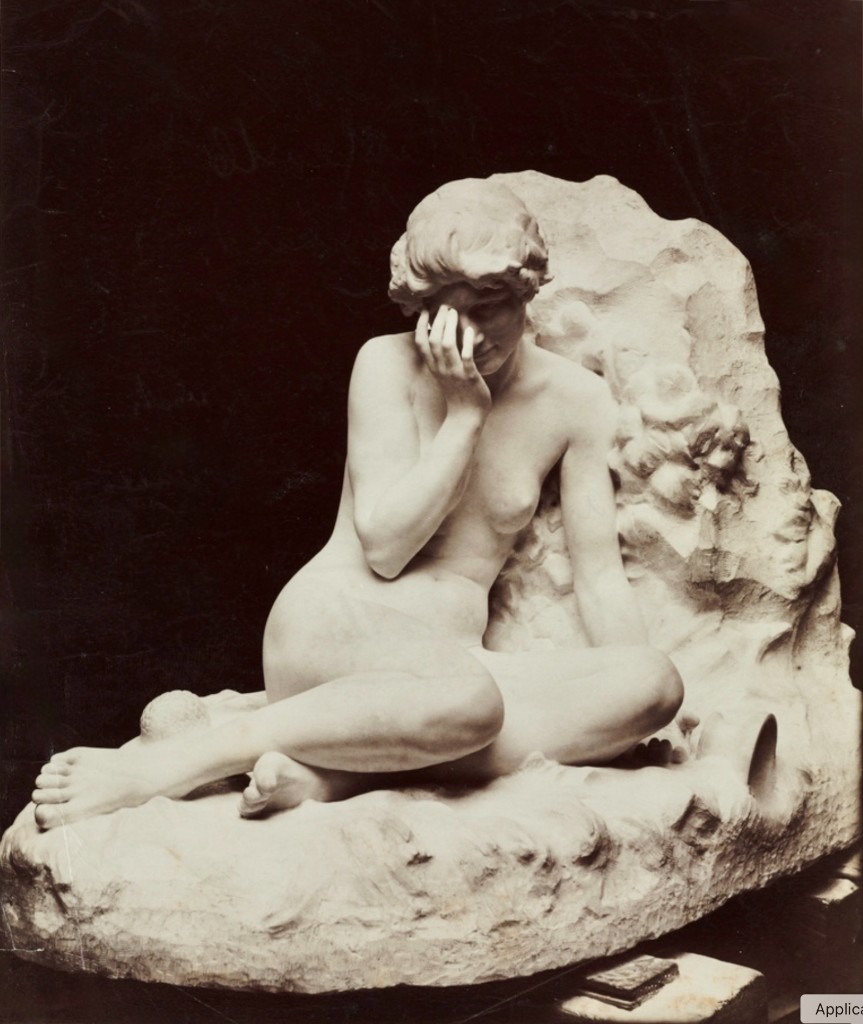
De Manneville’s ceramic production appears to have been limited and collaborative, and it belongs to a pattern the Bestiaire documents repeatedly. He was a sculptor who did not fire, and his ceramics exist because two of the period’s editing ceramists took up his models. He worked with Edmond Lachenal on Pleureuse assise, entrusting his sculptural model to a ceramist capable of translating it into fired clay and glaze; Lachenal did the same for Agnès de Frumerie and others. His best-known ceramic design was produced with Alexandre Bigot, who ran one of the most active such workshops of the period and whose roster included Camille Alaphilippe and Pierre Roche. In this division of labor de Manneville supplied the sculptural conception, while Bigot’s workshop realized the work in high-fired stoneware and gave its surfaces their subdued, earthy coloration. The arrangement is the same one that produced the collection’s Bigot-edited pieces, and it is the reason a sculptor with almost no ceramic output of his own belongs in a ceramic bestiary at all.
The design itself is a snake coiled around the stem of a chanterelle mushroom and bending toward the water collected in its broad cap. The Snake Drinking from a Chanterelle is an exceptionally complete expression of Art Nouveau’s desire to fuse sculpture, nature and function. The mushroom becomes both pedestal and basin, while the snake’s spiraling body binds the composition together and directs the eye upward toward the pool of green glaze. Several variants are known, including an example mounted upon bronze ivy leaves, indicating that the model enjoyed some success despite de Manneville’s otherwise small ceramic output — and indicating, too, that it passed through the hands of a mounter as well as a ceramist, so that a single conception could reach its owner through three trades.
Within the Bestiaire, the work is important not because de Manneville frequently represented animals, but because this single conception transforms an observed encounter between creature and habitat into a unified ceramic organism. The snake is not applied to a vessel; it is the reason the vessel has the shape it has, and the mushroom is not a pedestal decorated with an animal but the animal’s drinking place. Few objects of the period state the collection’s central proposition so economically.
References
Arthur, Paul. French Art Nouveau Ceramics: An Illustrated Dictionary. Paris: Éditions Norma, 2015, pp. 260–261. Page 260 reproduces the snake-and-chanterelle coupe at full-page scale, followed by the entry for de Manneville on page 261.
Bédague, Hélène. Alexandre Bigot, chimiste et céramiste. Paris: Éditions Louvre Victoire, 2016, pp. 128–129. These pages discuss de Manneville’s collaborations with Edmond Lachenal and Alexandre Bigot and illustrate two variants of the snake-and-chanterelle model. The bilingual monograph is the strongest object-specific source.