Artist Dossier
Auguste Delaherche
Independent potter and glaze innovator; peacock-feather plates among the Bestiaire’s defining bird motifs.
Biographical Note
Brief biography for this individual (typically three paragraphs; five maximum).
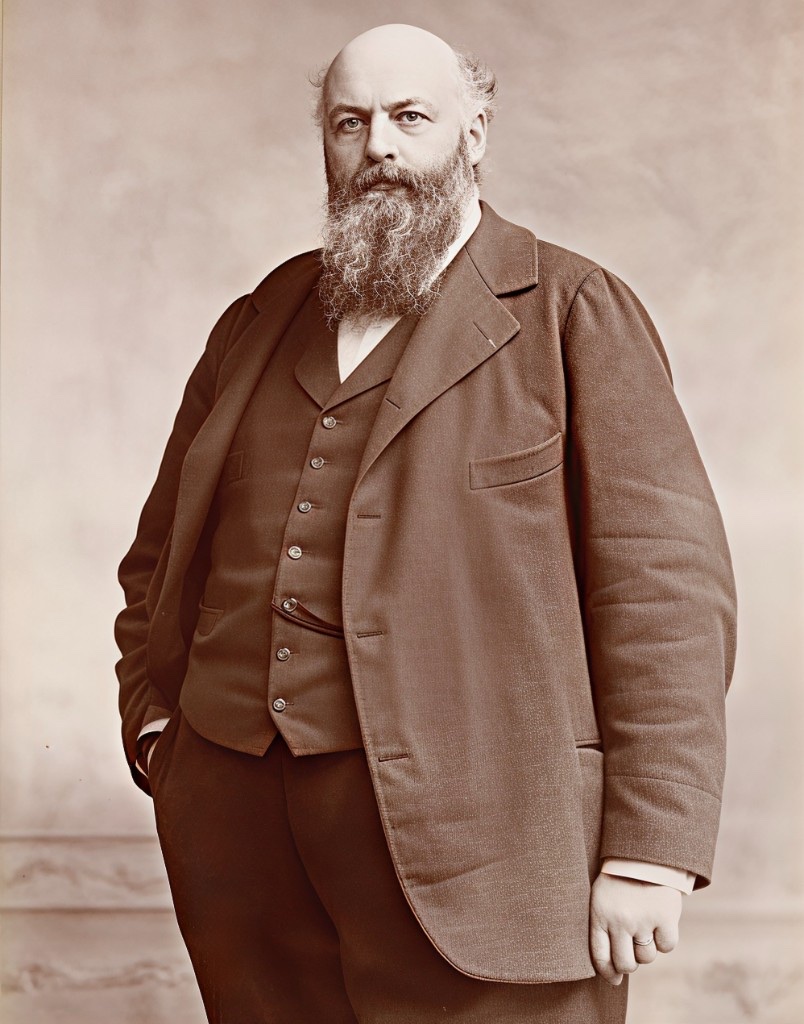
Auguste Delaherche was one of the leading figures in the transformation of French ceramics from decorative manufacture into an independent artistic practice. He was born at Beauvais in December 1857, son and nephew of textile manufacturers of the town, and grew up around the pottery of the Beauvaisis — a paternal uncle was a serious collector who owned major examples of it. He entered the École des arts décoratifs in Paris in 1877 and remained until 1882, with an interruption for military service, taking courses in stained glass and metalwork; as a draftsman he worked under Edmond Lechevallier-Chevignard on the restoration of the windows at Écouen and on new glass for the chapel of the château de Chantilly. He began making art pottery in 1883, the year he met Ludovic Pilleux, a ceramist at the manufactory called L’Italienne at Goincourt outside Beauvais, and went to work in his kilns. In 1886–87 he was a designer and head of the galvanoplasty department at Christofle — a post that followed his first pots rather than preceding them, though several accounts reverse the order. A gold medal at the Union centrale des arts décoratifs in 1887, where he showed vases, pots and dishes decorated with mistletoe, carnation and clover, settled the question of what he was; on 4 October of that year he bought Ernest Chaplet’s workshop at 153 rue Blomet in Vaugirard — the studio Chaplet had run for Haviland — and set up as an independent potter.
Rue Blomet gave him seven years and a teacher. It was from Chaplet that he took the high-fired flambé stonewares under glaze, and the flowed and graduated glaze effects that became his signature. Rather than relying on elaborate modeling or densely incised ornament, he concentrated on the relationship among silhouette, clay and glaze. His bottles, jars, chargers and handled vessels draw upon Greek, rustic French and East Asian pottery while remaining unmistakably modern. Copper reds, greens, violets, blues and deep browns flowed across rounded or strongly ribbed forms, gathering along edges and shifting with the contours of the vessel. A second gold medal followed at the Paris Exposition Universelle of 1889 and a third at that of 1900. Samuel Bing showed his work at L’Art japonais, which is the documented channel for the Japonisme in it. One qualification matters for cataloguing: the wares of these Paris years were made in multiples and were in heavy demand after 1889. The rue Blomet production was an edition practice, not yet the one-off practice of his later life.
Unlike most ceramists represented in the Bestiaire, Delaherche was not an animalier. His principal connection to the animal kingdom was the peacock feather, which became one of the most recognizable motifs of his early maturity. Between approximately 1887 and 1894 he decorated chargers and vases with sweeping barbs and brilliant eyespots whose blues, greens, reds and purples exploit the full chromatic range of the glaze. The feathers are not presented as trophies detached from a bird; they expand, overlap and rotate until plumage becomes an almost abstract system of line, color and movement. Their cropped, asymmetrical arrangements reflect Japonisme, while their luxuriant eyespots anticipate the ornamental rhythms of Art Nouveau. The motif carried well beyond him: the Musée des Arts Décoratifs, which holds both a peacock-feather vase of about 1889 — painted and engraved on a white slip under blue glazes and a crackled, green-tinted lead varnish, a treatment the museum likens to Persian faience — and a dish in the same manner, credits the theme with inspiring wallpaper and textile publishers and Art Nouveau jewelers across the following two decades. Nor was the peacock only a motif of his early maturity. When he turned to architectural ceramics between 1925 and 1930 he made the Cheminée aux Paons for the château de Léoubes at Bormes in the Var, alongside the mural decoration of the façade of the Lycée Victor Hugo in Paris. The bird brackets the career at both ends.
In 1894 he left Paris for good. He had prepared the move, renting a house at Héricourt in the commune of la Chapelle-aux-Pots through the summers of 1891 and 1892 and firing at Bertin’s and Mesanguy’s; he now had the architect Charles Genuys build him a house, a kiln and workshops near Armentières, the property he named Les Sables Rouges. He was seldom seen in Paris afterward, though the best galleries went on selling him, and he acquired a mild Parisian legend as a rural hermit — the period nickname poète du grès caught the same idea. The decisive change came in 1904. He let his assistants go and sat down at the wheel himself, having until then, like most ceramists of his generation, had a workman throw his designs. His reasoning survives: a hired thrower must necessarily repeat himself, since the artist cannot supply a fresh drawing for every vase, and the work takes on a certain monotony or coldness — whereas an artist handling the clay finds the form arriving under his fingers as he works. From 1904 the preparatory drawings handed to the throwers stop, and the pieces are unique. His work became progressively more restrained and personal: applied or painted decoration diminished while irregular profiles, subtle asymmetry and the behavior of the glaze assumed greater importance. He moved by stages from stoneware into porcelain, specializing latterly in openwork and extreme translucency, and by the 1920s was pursuing Near Eastern ceramics in a body ever whiter. The resulting vessels can appear strikingly simple, yet their quiet forms carry surfaces of extraordinary depth — clouded, streaked, crystallized or broken into delicate tonal transitions by the fire.
Delaherche’s importance lies in this conviction that a pot could be a complete work of art without narrative subject matter or sculptural display. Alongside Ernest Chaplet, Jean Carriès and Théodore Deck he helped establish the autonomous artist-potter as a central figure in modern French decorative art, and he held the position combatively: he went so far as to petition the State by open letter to close the manufacture nationale de Sèvres, whose subsidized competition he judged unfair to independent artists. He left Armentières in 1940 when the bombardment of Beauvais made staying impossible, and died in Paris on 27 June of that year, the journey having finished a man already worn down. Within the Bestiaire, his peacock-feather ceramics occupy a revealing position: the animal itself has disappeared, yet one of its most spectacular attributes has been transformed into pure ceramic movement. The feathers demonstrate that the Art Nouveau bestiary could operate not only through modeled creatures, but also through the abstraction of an animal’s color, texture and pattern.
References
Fonds Auguste Delaherche (1857–1940). Inventory of the artist’s archive, musée d’Orsay, Paris, 2020. Finding aid to the correspondence, accounts and family papers; also records the Jean Benoît-Lévy and René Chavance film Un grand potier: Auguste Delaherche, a copy of which is held by the CNDP.
Galiègue, Josette, Helen Bieri Thomson, Bernard Giguet, and Jean Cartier. Auguste Delaherche: rêves d’argile, secrets d’émail. Exhibition catalogue, Fondation Neumann, Gingins; Paris: Somogy, 2001.
Giguet, Bernard. Auguste Delaherche (1857–1940). Bulletin du Groupe de recherches et d’études de la céramique du Beauvaisis, no. 21, Beauvais, 1999, pp. 7–207. The most substantial specialist study.
Lecomte, Georges. A. Delaherche. Paris, n.d. 48 pp., 12 plates. An early monographic appreciation by a critic who knew him.
Massé, Marie-Madeleine. “Apprivoiser le feu.” In Hélène Sirven, Josette Galiègue et al., L’Idéal Art nouveau: une collection majeure du musée départemental de l’Oise. Paris: Gallimard, 2013.
La Saison d’art à Beauvais: expositions de céramiques anciennes et modernes du Beauvaisis. Grès et porcelaines de M. Aug. Delaherche. Exhibition catalogue, Beauvais, 4 June–10 October 1921, preface by Jean Ajalbert.
Salmon, Marie-José. Auguste Delaherche (1857–1940). Exhibition catalogue, Musée départemental de l’Oise, Beauvais, 1973. The MUDO holds the largest collection of his work, together with Pierre-Félix Masseau’s bust of him.
Tornier, Étienne. “Auguste Delaherche et les États-Unis (1889–1953).” Bulletin du Groupe de recherches et d’études de la céramique du Beauvaisis, 2012.